The business climate of the petrochemical industry retreated in August, with the chemical raw materials sector shifting into a sluggish range.


 简体中文
简体中文
 Русский
 Français
 Español
 Árabe
Árabe
 Deutsch
 Português
 日本語
日本語
 한국어
한국어
 हिंदी
हिंदी
 Prancis
 Türkçe
 Tiếng Việt
 Italiano
 ไทย
ไทย

News
The business climate of the petrochemical industry retreated in August, with the chemical raw materials sector shifting into a sluggish range.
The China Petroleum and Chemical Industry Federation recently released business climate monitoring data for the petroleum and chemical industry for August. The industry's business climate index fell by 1.02 percentage points month-on-month to 92.42, erasing the gains made in July and slipping back to the low end of the "cool" range.
Regarding international oil prices, after retreating from their highs in late July, prices resumed an upward trend in August, characterized by wide fluctuations at elevated levels. Market risk premiums have persisted due to geopolitical tensions.
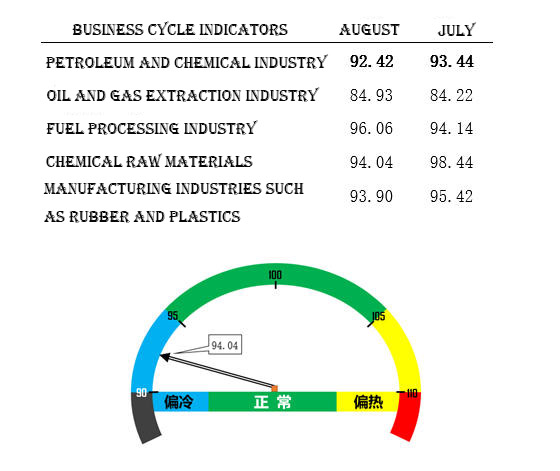
Industry sectors show clear divergence:
The cost-profit margin in the oil and gas extraction industry shifted from positive to negative; the business climate index rose slightly but remained in the "over-cooled" range.
The fuel processing industry benefited from rising gasoline and diesel prices; profits in the refining sector improved, and the industry's business climate index rebounded by 1.92 percentage points month-on-month to return to the normal range, making it a highlight of the month.
Manufacture of Chemical Raw Materials and Chemical Products: The business climate index for this sector stood at 94.04, down 4.40 percentage points month-on-month, shifting from the "normal" range to the "cool" range. The primary reason is the inefficient transmission of value along the profit chain. Although prices for basic chemicals rose in tandem with costs, weak end-market demand limited the extent of these increases and obstructed price pass-through; consequently, product price hikes failed to keep pace with rising input costs, severely squeezing profit margins. Meanwhile, inventory turnover slowed, leaving the industry grappling with simultaneous declines in volume and price alongside an involuntary accumulation of inventory.
The rubber, plastic, and polymer products manufacturing industry is also grappling with insufficient end-market demand; the cost-profit margin has turned negative, and the business climate index has fallen by 1.52 percentage points, dropping into the "cool" range.
[Disclaimer] The industry boom analysis in this article is only for sharing industry information and does not constitute any product purchasing, sales, or investment advice.
Online message
Join Our Newsletter And Stay Updated On The Latest Trends In Digital Design.
-
Quick Link
-
Products
-
Contact Us
Room 1608, 16th Floor, Block A, Huijin Building, No. 101-9 Lutai Avenue, High-tech Zone, Zibo City, Shandong Province
RONGYUE

